Problem Form
Streamline problem management processes by customizing forms to efficiently capture and categorize problem-related information.
This document guides IT administrators, IT staff, and implementation consultants through customizing problem forms. It covers modifying default templates, adding custom fields, and configuring existing fields to enhance data collection for problem diagnosis, resolution, and analysis, and to leverage automation settings.
Navigating to the Problem Form
To access and configure custom fields for problem management, go to Admin > Problem Management > Problem Form. The page will appear, displaying the current layout of your problem form.
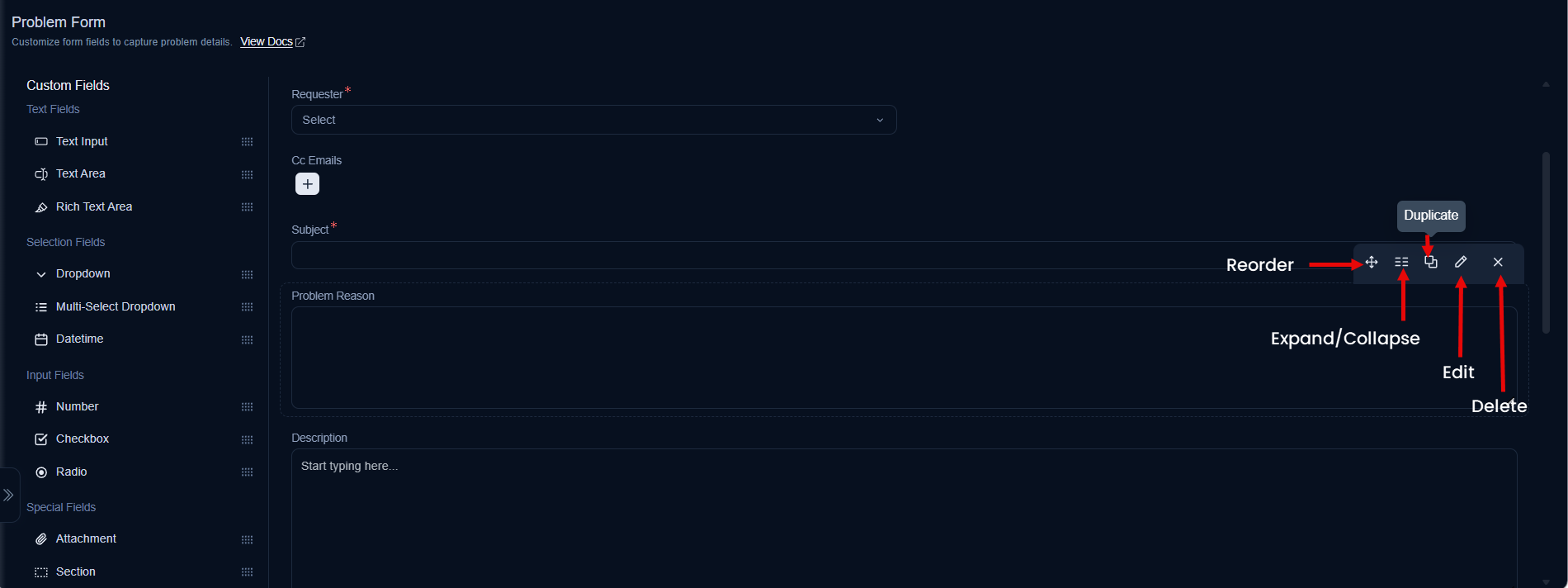
The page displays two types of fields:
System Fields
System fields are the core, built-in fields that form the foundation of any problem record. While some properties can be adjusted, they cannot be removed. Key system fields include:
- Fill From Template
- Transition Model
- Requester (mandatory)
- Cc Emails
- Subject (mandatory)
- Description
- Status
- Due By (mandatory)
- Nature Of Problem (mandatory)
- Known Error (mandatory)
- Priority
- Urgency
- Impact
- Category
- Technician Group
- Assignee
- Department
- Vendor
- Location
- Tags
- Attachment
Understanding Field Types
- Default Fields: These are the primary, built-in fields that come with the initial installation of the system. Default fields are essential for core problem processes; their names cannot be changed, and they cannot be deleted.
- Custom Fields: These are additional fields that can be added to the problem form from the Field Pallet. Custom fields provide flexibility to meet specific organizational needs. They can be renamed, modified, and deleted as required.
Customizing the Problem Form
When managing fields on the problem form canvas, various customization options are available to help you arrange and configure fields effectively. These options include:
- Reorder: You can easily change the display order of fields on the form. Simply drag and drop any field to its desired position within the form layout. This option is available for both default and custom fields.
- Expand/Collapse: This option allows you to adjust the visual width of fields. You can set a field to expand to a full row (1 in a row) or collapse to occupy half a row (2 in a row), enabling a more compact form design. This option is available for both default and custom fields.
- Duplicate: For custom fields, you can create an exact copy with all its configurations. This is useful for quickly adding similar fields without rebuilding them from scratch. This option is available only for custom fields.
- Edit: This option opens a configuration pop-up for the selected field, allowing you to modify its properties. You can change the field's name, set it as mandatory, define default values, show on the problem form, and adjust other field-specific characteristics. For default fields, some editing options may be restricted.
- Remove: You can delete custom fields from the problem form. This option is not available for default fields.
Deleting a custom field will permanently remove it and all its associated data from existing problem records.
Adding Custom Fields
The Field Pallet (located on the left sidebar) provides a variety of custom field types that you can add to your problem form. To add a new field, simply drag and drop the desired field type from the pallet onto the form canvas.
For detailed information on each custom field type, including its specific configuration options, use cases, and how to set up properties like default values, character limits, and permissions, please refer to the Request Form documentation. This linked resource provides comprehensive guides for fields such as:
- Text Fields: Text Input, Text Area, Rich Text Area
- Selection Fields: Dropdown, Multi-Select Dropdown, Datetime
- Input Fields: Number, Checkbox, Radio
- Special Fields: Attachment, Section, Label, URL, and Currency
- Advanced Fields: Dependent