SLA
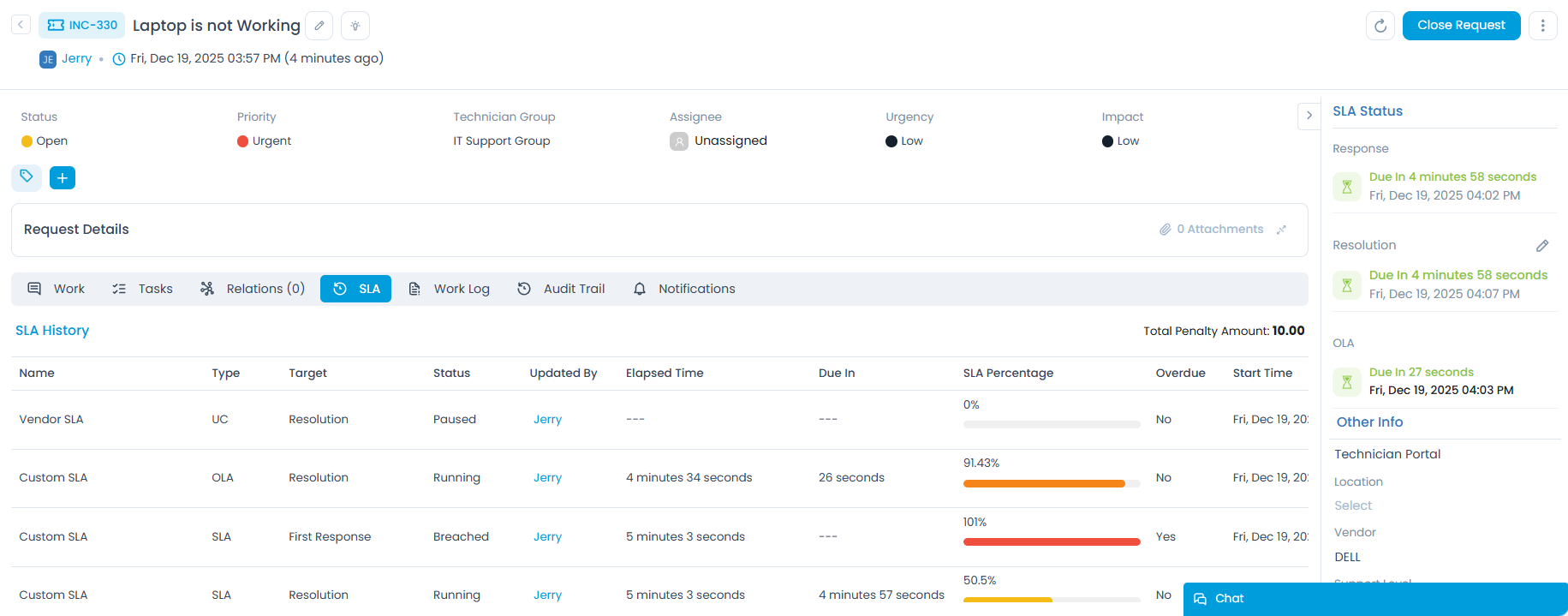
The SLA tab and the ticket details page provide a comprehensive view of all Service Level Agreements (SLAs), Operational Level Agreements (OLAs), and Underpinning Contracts (UCs) applied to tickets. The ticket details prominently display key SLA information such as the total penalty amount, SLA name, type, target, status, who updated it, elapsed time, due in, SLA percentage, overdue status, and start time.
| Parameters | Description |
|---|---|
| Name | Displays the name of the currently applied SLA, OLA, or UC. For Example: If a Medium Priority SLA is applied to the ticket, the value is shown as Medium Priority SLA. |
| Type | Indicates the category of the SLA currently applied to the ticket. The value can be SLA, OLA, or UC. - SLA (Service Level Agreement): Applied when a ticket is created or updated, typically based on its priority or predefined SLA conditions. For Example: When a ticket is logged with Medium priority, the default Medium Priority SLA is applied and the Type is shown as SLA. - OLA (Operational Level Agreement): Applied when a technician group is assigned to the ticket and an OLA is configured for that group. For Example: Once a technician group with an associated OLA is assigned, the Type changes to OLA. - UC (Underpinning Contract): Applied when a vendor is associated with the ticket and a UC is configured for that vendor. For Example: When a vendor is updated on the ticket, the UC SLA becomes active and the Type is displayed as UC. Each time an SLA, OLA, or UC is applied, it appears as a separate entry in the SLA History list. |
| Target | Displays the target of the currently applied SLA/OLA/UC. If Response timer is applied, First Response will be displayed. If Resolution time is applied, Resolution will be displayed. For Example: If the agreement tracks fixing the ticket, Target shows |
| Status | Displays the current status of the applied SLA, OLA, or UC. The possible values are: - Running: Indicates that the SLA, OLA, or UC timer is currently active. - Achieved: Indicates that the configured target (first response or resolution, as defined in the SLA) has been met. - Breached: Indicates that the SLA, OLA, or UC's total duration time has been exceeded. - Cancelled: Indicates that the SLA, OLA, or UC was stopped because a new SLA, OLA, or UC was applied while the previous one was still running. - Paused: Indicates that the SLA or UC timer was temporarily stopped because the ticket moved to a status where Run SLA or Run UC is disabled. For OLA, the timer is paused when the technician group is changed. |
| Updated By | Indicates who triggered the SLA update. Shows the username for manual actions or System for automatic SLA, OLA, or UC processing. For Example: If a technician group change by Larry applies an OLA, Larry is displayed. |
| Elapsed time | Displays the actual time consumed by the SLA, OLA, or UC, calculated based on the assigned operation hour type. Only the time during which the SLA/OLA/UC is actively running is counted; paused durations are excluded. Example: If the SLA starts at 9:00 AM, is paused for 1 hour, and is checked at 2:00 PM, the Elapsed Time shows 4 hours. |
| Due In | Shows how much time is remaining before the SLA, OLA, or UC deadline is reached, considering the configured business hours. This value decreases as time passes and helps track how close the ticket is to breaching the defined target. Example: For an 8-hour resolution target with 7 hours already used during business hours, Due In displays 1 hour. |
| SLA Percentage | Shows how much of the SLA, OLA, or UC time has been consumed, calculated as (Elapsed Time ÷ Total Duration) × 100. • 0–50% – Green (well within target) • 51–75% – Yellow (approaching target) • 76–100% – Orange (near breach) • >100% – Red (breached) Example: If 7 out of 8 hours are used, the SLA Percentage is 87.5% (orange). After breach, the value exceeds 100% (red). |
| Overdue | Displays whether the SLA/OLA/UC has been breached. For Example: When the elapsed time exceeds the target duration, Overdue is shown as |
| Start Time | Displays the date and time when the SLA, OLA, or UC was applied to the ticket. For Example: If the SLA is applied to the ticket at 9:00 AM, Start Time shows |
| Last Pause Time | Displays the most recent time when the SLA, OLA, or UC timer was paused due to ticket status changes (Run SLA / Run UC disabled) or technician group changes. For Example: Changing the ticket to a status like “Pending Vendor” can pause the timer. |
| Stop Time | Displays the time when the SLA/OLA/UC was stopped or cancelled for the ticket. For Example: When the ticket is resolved at 7:00 PM, Stop Time shows |
| Pause Duration | Displays the total duration for which the SLA, OLA, or UC was paused. For Example: If the SLA is paused from 1:00 PM to 2:00 PM, Pause Duration shows |
| Breached Duration | Displays the total time for which the SLA, OLA, or UC remained in a breached state. For Example: If the SLA is due at 5:00 PM and the ticket is resolved at 7:00 PM, Breached Duration shows |
| Penalty Amount | Displays the total penalty applied when an SLA, OLA, or UC is breached, based on the configured penalty type. Examples: 1. Fixed penalty only: If the fixed penalty is 2. Cumulative penalty: If the cumulative penalty is 3. Cumulative penalty (Apply penalty once for configured unit enabled): If the penalty is 4. Cumulative penalty (Apply Response breach penalty enabled): If the one-time Response breach penalty is 5. Cumulative penalty (Apply Resolution breach penalty enabled): If the one-time Resolution breach penalty is |
| Technician Group | Displays the technician group associated with the OLA. For Example: If the OLA is owned by a team, it can show a group like |
| Operational Hours Type | Displays the operational hours used for SLA calculation. Possible values are Calendar Hours and Business Hours. For Example: |
| Update Count | Indicates the number of times an SLA/OLA/UC has been activated or resumed (after a pause). For Example: If the SLA started once and was paused (due to status change in which Run SLA or Run UC is disabled)/resumed once, Update Count can show 2. |