Creating a CI
ServiceOps gives you four ways to add a CI to your CMDB. Choose the method that fits your situation and follow the steps below.
Which Method Should You Use?
Use this table to pick the right method before you start.
| Method | Best For |
|---|---|
| Discovery | Automatically finding and adding devices already on your network |
| Manual | Adding a single CI that discovery cannot detect, such as a cloud service or SaaS tool |
| Sync Rule | Automatically creating a CI whenever a matching asset is added |
| Workflow | Creating CIs as part of a larger automated IT process |
Before creating CIs via discovery or sync rules, an administrator must configure CI types and statuses in Admin > CMDB, and set the Discovery Preference Rule to CI. See CI Type Configuration and CI Status Configuration.
Prerequisites
Before you start, confirm the following:
- You have a CMDB license assigned to your account.
- You have the CMDB Specialist Technician role.
- You have the Manage CMDB permission (required for sync rules).
Steps
- Via Discovery
- Manually
- Via Sync Rule
- Via Workflow
Discovery scans your network and automatically creates CIs for every device it finds. This is the fastest way to populate your CMDB at scale.
Step 1. Navigate to Admin > Discovery and Agents > Discovery.
Step 2. Select the scan type that matches your environment: Network Scan, Public Cloud Network, Private Cloud Network, Domain Scan, or SCCM Scan.
Step 3. Click Create Scan, fill in the required details such as IP range, credentials, and scan name, then click Save.
Step 4. Click Scheduler next to the scan you just created.
Step 5. Select the Discovery Scan Schedule tab and click Create Discovery Schedule.
Step 6. Choose a Schedule Type: Once, Daily, Weekly, Monthly, or Interval.
Step 7. Enable Automatically add Entities in Asset/CI list to add discovered devices to the CI list without manual approval.
Step 8. Click Save.
To run the scan without waiting for the schedule, click Run Now from the scan list page.
Step 9. Once the scan completes, navigate to CMDB. Your discovered CIs appear on the CI List page.
Manual creation lets you add any CI directly from the portal. Use this for CIs that discovery cannot detect.
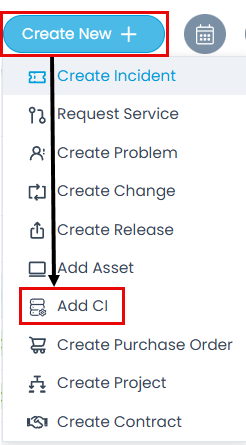
Step 1. Click Create New + at the top of any page and select Add CI. The CI creation form appears.
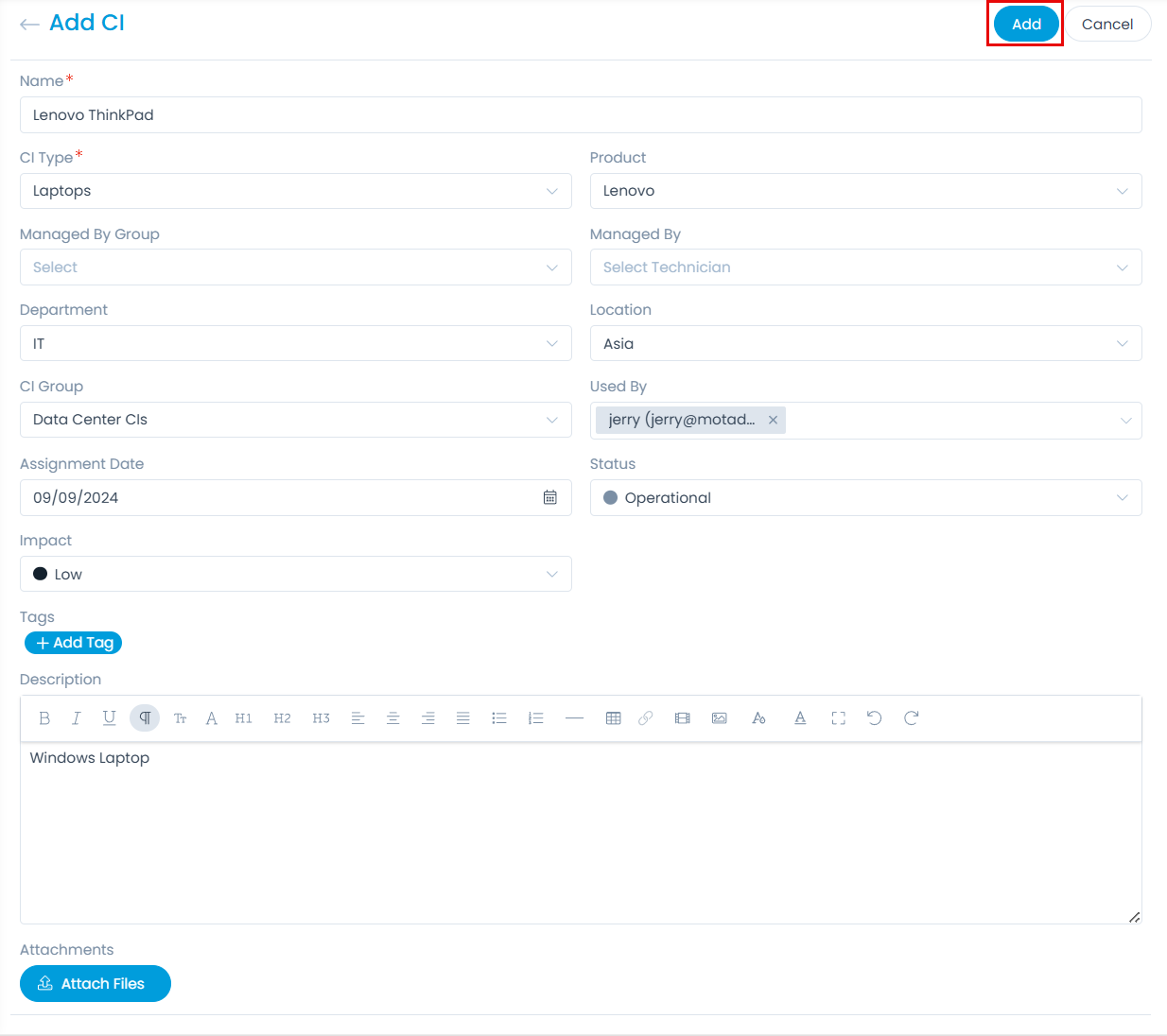
Step 2. Enter the following details:
| Field | Description |
|---|---|
| Name | Enter the name of the CI. |
| CI Type | Select the type of CI. |
| Product | Select the product from the dropdown or search by name. |
| Managed By Group | Select the group responsible for managing this CI. |
| Managed By | Select the technician who owns this CI. |
| Department | Select the department the CI belongs to. |
| Location | Select the physical or logical location of the CI. |
| CI Group | Select the CI group this CI belongs to. |
| Used By | Select the person who uses this CI. |
| Assignment Date | Select the date the CI was assigned to the user. |
| Status | Select the current status: Operational, Non-Operational, In Maintenance, or Retired. |
| Impact | Select the business impact: Low, On Users, On Department, or On Business. |
| Tags | Enter tags to categorize and filter this CI. You can also add tags automatically using a Workflow. |
| Description | Enter a short description of the CI. |
| Attachments | Attach supporting documents or images. Once attached, you can preview or delete them. |
Step 3. Click Add. The CI is created and appears on the CI List page with an auto-generated ID such as CI-1.
A sync rule automatically creates a CI whenever you add an asset that matches a defined condition. Use this when your asset and CI records need to stay in sync without manual effort.
Only users with the Manage CMDB permission can create sync rules. If you do not have this permission, ask your administrator to configure the sync rule under Admin > CMDB > CI Type.
Step 1. Navigate to Admin > CMDB > CI Type.
Step 2. Click the CI type you want to configure, for example Hardware.
Step 3. Select the Sync Rule tab and click Create Sync Rule.
Step 4. Enter the following details:
| Field | Description |
|---|---|
| Name | Enter a name for the sync rule. |
| Description | Enter a brief description of what this rule does. |
| Enable Asset Creation on CI Creation | Turn on to create an asset automatically when a matching CI is created. Select the condition and asset type to create. |
| Enable CI to Asset Field Mapping | Turn on to map CI fields to asset fields based on condition groups. Up to 5 condition groups are supported. |
Step 5. Click Create. The sync rule is saved and enabled by default.
Step 6. To test the rule, create an asset that matches the condition you defined. Navigate to CMDB and confirm a new CI appears on the list.
If you have multiple sync rules, drag them on the list page to set priority. The top rule runs first.
A workflow creates CIs automatically as part of a larger automated process. Use this when CI creation must happen as a step in an incident, change, or request workflow.
Step 1. Navigate to Admin > Automation > Workflow.
Step 2. Click Create Workflow and select the trigger event that should start the workflow.
Step 3. Add a workflow step and select Execute Sync Rule as the action.
Step 4. Select the sync rule you want to execute. The sync rule must already exist under the matching CI type. See the Via Sync Rule tab above if you have not created one yet.
Step 5. Set any conditions to control when the workflow fires.
Step 6. Click Save and enable the workflow.
Step 7. Trigger the workflow and navigate to CMDB to confirm the CI was created on the CI List page.
After Creating a CI
Once your CI appears on the CI List page, complete these steps:
- Open the CI and review the CI Details page to fill in any missing properties.
- Map the CI status to your asset statuses so that status changes stay in sync.
- Add relationships to link this CI to other hardware, software, or services it depends on.
- Associate the CI with existing requests, problems, changes, or releases where relevant.
Troubleshooting
Common issues when creating a CI for the first time.
Add CI option is missing from the Create New menu
Cause: Your account does not have the CMDB Specialist Technician role or the Manage CMDB permission.
Fix: Ask your administrator to assign the correct role and permission under Admin > User Management. Log out and back in after the change.
Discovery scan completes but no CIs appear in the CI list
Cause: The Discovery Preference Rule is not set to CI, or Automatically add Entities in Asset/CI list was not enabled in the schedule.
Fix: Ask your administrator to navigate to Admin > Discovery and Agents > Discovery and confirm the Discovery Preference Rule is set to CI. Then edit the Discovery Schedule and enable Automatically add Entities in Asset/CI list.
Sync rule is enabled but no CI is created when an asset is added
Cause: The asset does not match the conditions defined in the sync rule, or a higher-priority rule already matched first.
Fix: Open the sync rule under Admin > CMDB > CI Type > Sync Rule and verify the condition. If multiple rules exist, check the priority order and move the intended rule higher.
CI Type is not available in the manual creation form
Cause: The CI type has not been created in the system.
Fix: Ask your administrator to navigate to Admin > CMDB > CI Type and add the missing CI type. See CI Type Configuration.