Core Components
Understand the foundational building blocks of ServiceOps to optimize performance, troubleshoot effectively, and design seamless integrations.
The ServiceOps platform is engineered with a robust, layered architecture designed for scalability, security, and efficient IT service delivery. This section provides an in-depth look at the core components that constitute the ServiceOps ecosystem, explaining their roles and interdependencies. Understanding these elements is crucial for IT Administrators managing deployments, Solution Architects planning system designs, and even Technicians seeking a deeper insight into how their daily operations are supported by the underlying infrastructure.
Architectural Layers and Core Services
ServiceOps is structured into distinct layers, each responsible for specific functionalities, ensuring modularity and efficient operation. Below are the key layers and their primary components:
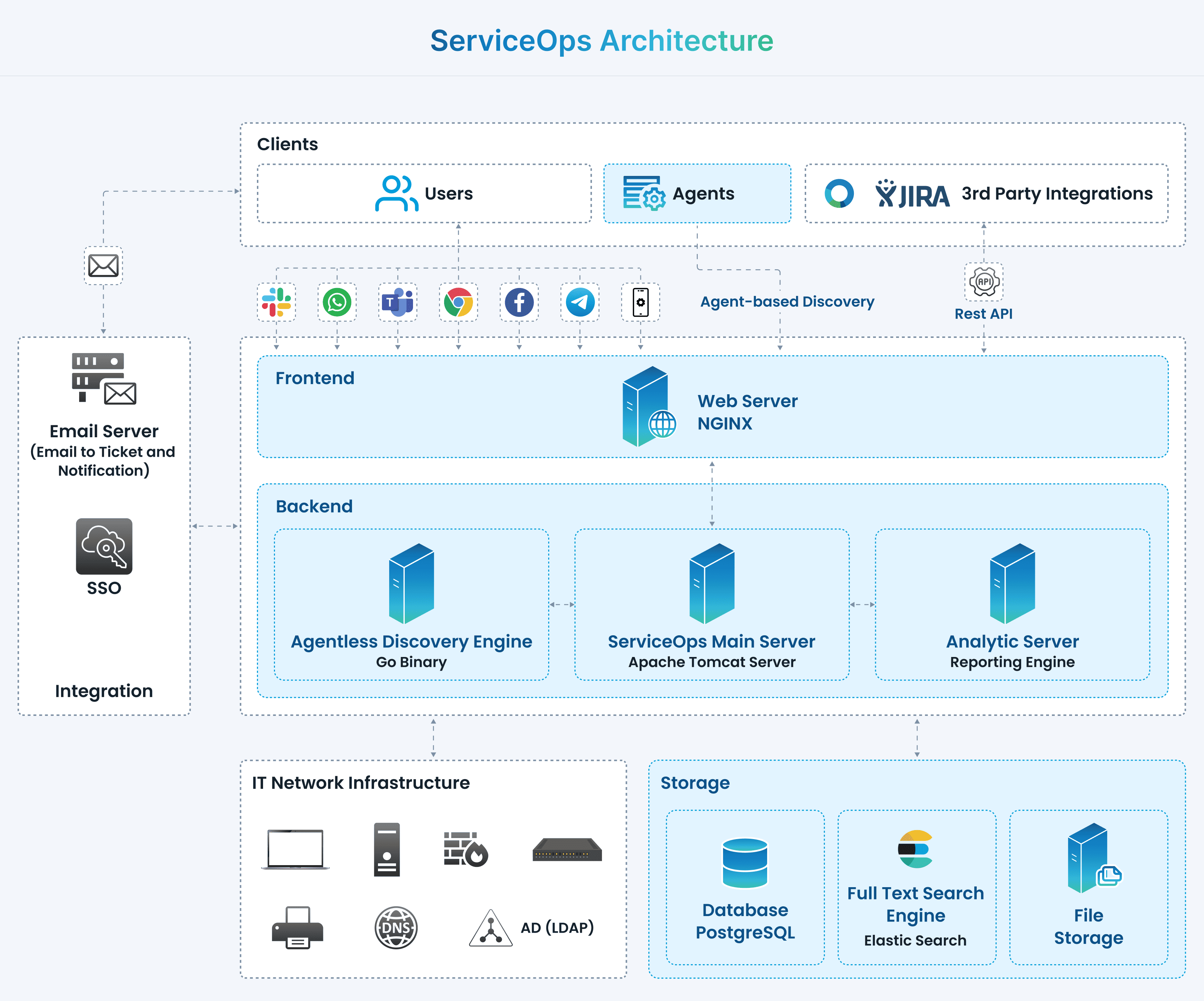
1. Clients and Integrations
This outermost layer represents how users and external systems interact with ServiceOps. It encompasses:
- Users & Agents: End-users accessing the self-service portal, and IT staff/technicians utilizing the ServiceOps application for their daily tasks.
- 3rd Party Integrations: Connections with external systems like Jira, Slack, WhatsApp, Microsoft Teams, and other platforms, enabling seamless data flow and enhanced functionality. This also includes Single Sign-On (SSO) and Microsoft 365 integration for authentication and email notifications.
- Agent-based Discovery & Rest API: Mechanisms for discovering assets within your network (via agents) and programmatic access to ServiceOps functionalities for custom integrations.
2. Frontend Layer
The frontend layer is responsible for presenting the user interface and handling client requests.
- Web Server (NGINX): Acts as the entry point for all client requests, serving web content and directing traffic to the appropriate backend services. NGINX ensures efficient load balancing and secure communication.
3. Backend Layer
This layer comprises the core processing engines and application logic of ServiceOps.
Agentless Discovery Engine (Go Binary): A high-performance engine written in Go, responsible for discovering IT assets across the network without requiring agents on every device. It identifies and collects information about various hardware and software components.
ServiceOps Main Server (Apache Tomcat Server): The central hub of the ServiceOps application, hosting the primary business logic, managing workflows, and coordinating interactions between all other components. It processes requests, manages data, and ensures the smooth operation of ITSM functionalities.
- Key Communication Ports:
- HTTP/HTTPS (80/443): Standard ports for web UI access.
- Analytics Server (8080-8082): Communication for reporting and data analysis.
- Plugin Server (5050): Interface for custom plugins.
- RDP Server (8443 / 4430): Ports for the Mesh RDP Server.
- Key Communication Ports:
Analytic Server (Reporting Engine): Dedicated to processing and generating reports, dashboards, and analytical insights from the collected data. It helps in visualizing key performance indicators (KPIs) and operational metrics.
4. IT Network Infrastructure
This layer represents the foundational network components that support ServiceOps operations.
- Email Server: Handles email notifications for incidents, service requests, changes, and other system alerts. It facilitates communication between the ServiceOps platform and users.
- DNS (Domain Name System): Essential for resolving domain names to IP addresses, ensuring that all ServiceOps components can communicate effectively within the network.
- AD (LDAP): Active Directory or LDAP integration for user authentication and synchronization, enabling centralized user management and single sign-on capabilities.
- Various Network Devices: Includes other network components like firewalls, routers, and switches that are part of the IT environment where ServiceOps is deployed.
Key Protocols and Services
ServiceOps leverages standard protocols to discover, manage, and integrate with the IT environment:
| Service/Protocol | Port(s) | Purpose |
|---|---|---|
| SSH | 22 | Secure remote access for managing Linux-based systems. |
| SNMP | 161 | Monitoring and managing network devices (routers, switches). |
| WMI | 135, 445, 49152-65535 | Agentless discovery and management of Windows systems. |
| LDAP/LDAPS | 389/636 | Integration with Active Directory for user synchronization. |
| Email Protocols | 25, 465, 587, 995, 110, 993, 143 | Sending notifications and fetching emails to create tickets. |
5. Storage Layer
The storage layer is critical for data persistence and retrieval.
- Database (PostgreSQL): The primary relational database used to store all operational data, configurations, and transactional information for ServiceOps.
- Full Text Search Engine (Elastic Search): An advanced search engine that provides fast and efficient full-text search capabilities across all ServiceOps data, crucial for quick incident resolution and knowledge base access.
- File Storage: Stores attachments, logs, and other non-structured data generated or used by the ServiceOps platform.
Communication and Data Flow
In the ServiceOps architecture, communication generally flows from the Clients through the Frontend (Web Server NGINX) to the various services in the Backend Layer. The Main Server orchestrates most operations, interacting with the Discovery Engine, Analytic Server, and Storage Layer. External systems like Email Servers, SSO, and Microsoft 365 integrate for specific functions, as depicted in the architectural diagrams.