Understanding the Project Lifecycle
The project lifecycle in ServiceOps provides a structured framework for managing projects from initiation to closure, ensuring that each phase is properly planned, executed, and reviewed.
A project in ServiceOps progresses through a series of distinct stages. Each stage has a specific set of goals, activities, and deliverables that move the project closer to its successful completion. Understanding this lifecycle is a core concept for anyone managing large-scale initiatives.
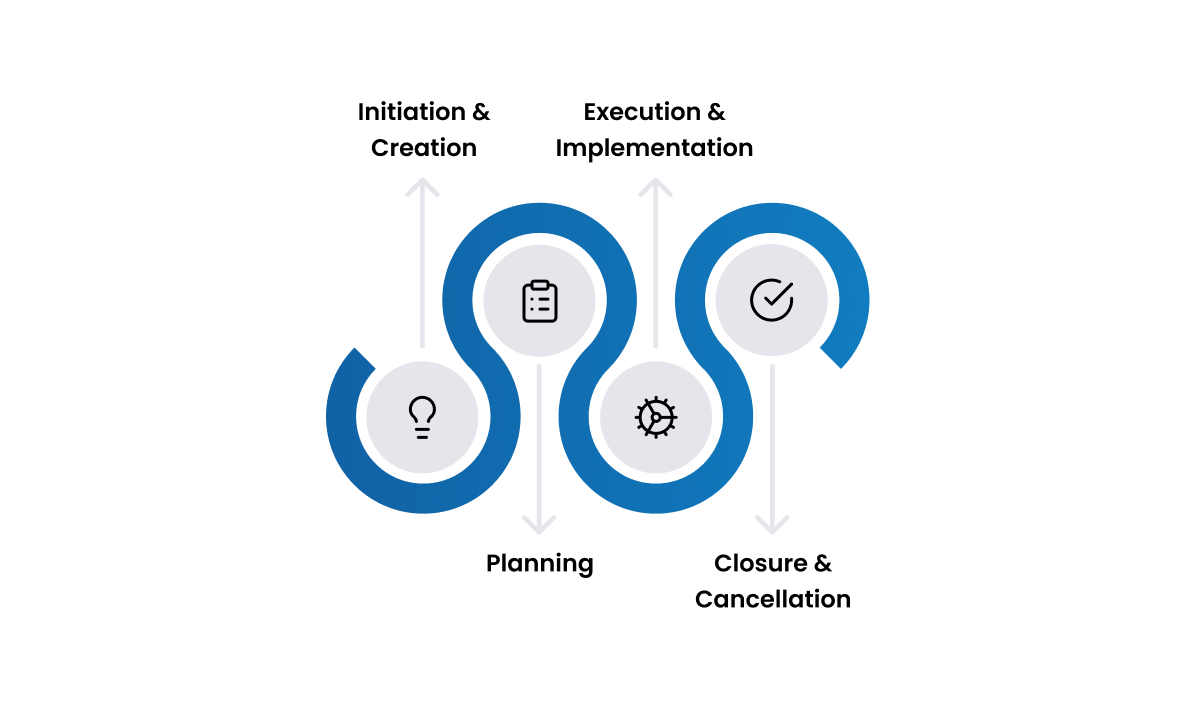
Project Management Lifecycle Stages
1. Initiation & Creation
This is the starting point of any project. The primary purpose is to define the project at a high level and create the initial project record in ServiceOps. A project is formally created with a title, description, and an assigned Project Owner, and basic properties like type, priority, and department are set.
A new project record exists in the Open state, ready for detailed planning.
2. Planning
This is the most critical phase, where the roadmap for the entire project is developed. The goal is to define the project scope, schedule, resources, and create a detailed plan of execution. Key activities include breaking down the work into summary tasks, tasks, and milestones; establishing schedules and dependencies; and assigning resources to the project and specific tasks.
A comprehensive project plan is documented in the Planning tab. The project remains in the "Open" state but now contains a full schedule and work breakdown.
3. Execution & Implementation
This phase is where the planned work is actively carried out to achieve the project's objectives. The project is moved into the Implementation stage, and technicians begin working on their assigned tasks. Progress is tracked at the task level, work logs are used to record time and effort, and Gantt charts provide a visual representation of progress against the timeline.
The project's deliverables are created, and the project status is moved to Implementation.
4. Closure & Cancellation
This is the final phase of the project, representing its conclusion. There are two primary outcomes:
- Project Closure
- Project Cancellation
A project is formally closed once it has been successfully completed. The Project Owner verifies that all tasks and milestones have been completed and then uses the Close Project action.
The project status is set to Closed. No further modifications can be made, but the record is retained for historical and reporting purposes.
A project is cancelled when a decision is made to terminate it before completion. The Project Owner uses the Cancel Project action, which is a terminal and irreversible action.
The project status is set to Cancelled. The project is considered inactive but remains in the system for auditing and review.
Related Topics
- Projects vs Tasks: Understanding the distinction between projects and tasks.
- Task Lifecycle: Learn about managing different types of work items in ServiceOps.