Article Lifecycle
The article lifecycle manages the complete journey of knowledge articles from creation to retirement, ensuring quality control and content relevance throughout their existence.
The article lifecycle encompasses all stages from initial creation to final retirement, with built-in quality controls and approval mechanisms. This process ensures that only high-quality, accurate, and relevant content reaches end users while maintaining proper version control and audit trails.
Lifecycle Stages
The article lifecycle follows a structured path to ensure content quality and relevance. Each stage represents a key step in the journey from creation to retirement, as illustrated below.
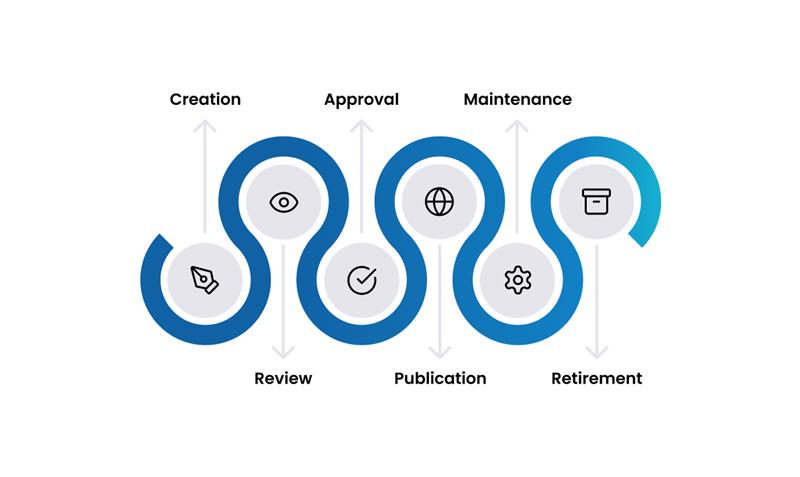
- Creation: The initial drafting of the article.
- Review: The article is reviewed for accuracy, clarity, and completeness.
- Approval: Subject matter experts provide formal approval.
- Publication: The article is made available to users.
- Maintenance: The article is periodically reviewed and updated.
- Retirement: The article is archived when it is no longer relevant.
1. Creation
The lifecycle begins when a knowledge author identifies the need for a new article. Using the rich text editor, the author develops comprehensive content, including text, images, and other media. During this stage, the author assigns essential metadata to ensure the article is well-organized and easily discoverable.
Key activities include:
- Developing clear, user-focused content.
- Structuring the article with logical headings and sections.
- Embedding relevant images, videos, and attachments.
- Assigning a descriptive title, relevant tags, and folder placement.
- Adding an optional expiry date for time-sensitive content.
2. Review
Once the draft is complete, it enters the review stage to ensure it meets quality standards. This process typically involves a self-review by the author, a peer review by subject matter experts for technical accuracy, and an editorial review for clarity, grammar, and style.
Articles are evaluated against the following criteria:
- Accuracy: Is the technical information correct and up-to-date?
- Completeness: Does the content comprehensively address the intended topic?
- Clarity: Is the information presented in a clear and understandable manner?
- Relevance: Is the content relevant and useful to the target audience?
- Usability: Does the article provide actionable information?
The system supports scheduled reviews, allowing specific reviewers to be assigned based on content type, with defined grace periods and automatic escalations for overdue reviews.
3. Approval
After a successful review, the article is submitted for formal approval. The system supports multiple approval mechanisms, from manual submission to automated workflows based on predefined rules. For sensitive content, multi-level approval hierarchies can be established.
Key approval decisions include:
- Unanimous: All approvers must approve the article.
- Majority: A majority of approvers must give their consent.
- Anyone: Any single designated approver can finalize the decision.
Throughout this stage, the article's state is tracked (e.g., Pending, Approved, Rejected), and approvers receive notifications to ensure a timely decision.
4. Publication
Once approved, the article is ready for publication. This can be triggered manually by an author, automatically by the system upon approval, or scheduled for a specific date and time.
Publication controls include:
- Access Control: Defining who can view the published article.
- Version Control: Maintaining a complete history of article versions.
- Rollback Capability: The ability to revert to a previous version if needed.
- Audit Trail: A comprehensive log of all publication activities.
5. Maintenance
Published articles require ongoing maintenance to remain accurate and relevant. This involves regular, scheduled reviews, performance monitoring based on usage, and incorporating user feedback.
When an article needs an update, an author revises the content, and the changes typically go through an abbreviated review and approval process before being republished. The system maintains a complete version history, allowing for easy tracking of modifications and the ability to roll back to previous versions.
6. Retirement
An article is retired when its content is outdated, has been superseded by a newer article, or shows consistently low usage. The retirement process involves assessing the impact on users, planning for replacement content if necessary, and finally moving the article to an archived state.
Archived articles are excluded from search results and have limited access, but they are retained for reference and can be restored if needed.
Best Practices
Best Practices for Article Lifecycle Management
- Define Clear Objectives: Ensure every article has a clear purpose and target audience.
- Standardize Your Structure: Use consistent formatting and templates to improve readability.
- Involve Multiple Reviewers: Engage peers and SMEs to ensure content is accurate and complete.
- Monitor Performance: After publication, track article usage and user feedback to identify areas for improvement.
- Schedule Regular Audits: Periodically review your entire knowledge base to retire outdated content and maintain quality.
Related Topics
- Knowledge Base: Features & Capabilities: For details on KB structure, capabilities, and integration with other modules.
- Incident Management: Creating knowledge articles from incident resolutions
- Change Management: Integrating knowledge with change processes
- Problem Management: Creating knowledge from problem solutions